Cofact invites everyone to examine and correct five common misconceptions about migrants in Thailand that have circulated on social media over the course of 2025:

#InternationalMigrantsDay, observed every year on 18 December. Cofact invites everyone to examine and correct five common misconceptions about migrants in Thailand that have circulated on social media over the course of 2025:
❌ Myanmar workers are demanding a wage of 700 baht per day
❌ The Ethnic Groups Act opens the door to granting 20 rai of land to foreigners
❌ Migrant workers have no right to assemble
❌ Thai citizens bear the healthcare costs of migrant populations
❌ The Thai government allows foreigners to obtain Thai citizenship
Full report
Thailand is home to a diverse population of foreign nationals. Many come from neighboring countries—Laos, Cambodia, and Vietnam—but the largest group comes from Thailand’s closest neighbor, Myanmar.
Prolonged war and conflict have driven large numbers of people from Myanmar to Thailand over the past four years. Some crossed rivers or fled aerial bombardment along the border for short periods before returning home. Others relocated for longer stays to seek work or pursue education. As a result, Thai society has begun to see this group more clearly and in greater numbers. Many Thais have expressed concern that migrants may compete for jobs and access to basic public services.
It is true that Thailand’s legal system is complex, incomplete, and leaves room for corruption at various stages. At the same time, discussions about the rights of foreign nationals are often shaped by prejudice or misunderstanding. This has led to sweeping stereotypes that migrants are making excessive demands, or to attacks on certain political parties accused of
prioritizing migrant workers over the interests of Thai citizens, even though many of these issues involve basic rights to which migrants are entitled.
On the occasion of International Migrants Day, observed annually on 18 December, the author invites readers to examine and correct common misconceptions about migrants that emerged in 2025—misunderstandings that could shape inaccurate long-term perceptions of foreign nationals in Thai society.
International Migrants Day
The United Nations adopted the International Convention on the Protection of the Rights of All Migrant Workers and Members of Their Families in 1990 and designated 18 December of each year as International Migrants Day. The purpose is to raise global awareness of the growing situation and challenges faced by migrants worldwide, and to promote the protection of human rights and labor rights for migrant workers in host countries.
The International Organization for Migration (IOM), a UN agency, defines a migrant as any person moving across an international border or within a country away from their usual residence, regardless of legal status, reason, or duration of stay, encompassing those moving voluntarily or involuntarily for various purposes like work, family, or study, and serving as an umbrella term for groups like refugees, economic migrants, and students.
1. Are Myanmar workers demanding a daily wage of 700 baht?
Earlier this year, shortly after Thailand announced an increase in the minimum wage to 400 baht per day, claims circulated online that Myanmar workers were demanding a daily wage of 700 baht. The claim sparked outrage on social media, with users attacking Myanmar workers for being “ungrateful” and “overreaching.”
This claim is false. Fact-checking organizations such as Cofact and AFP Fact Check found that the content was based on an old video of a Myanmar labor leader in Thailand giving a media interview four years earlier, before Thailand raised the minimum wage. The clip was reshared on Facebook and TikTok without context and was falsely linked to unrelated gatherings of Myanmar people in Thailand. This created misunderstandings and fueled hatred by portraying Myanmar workers as making unreasonable wage demands.
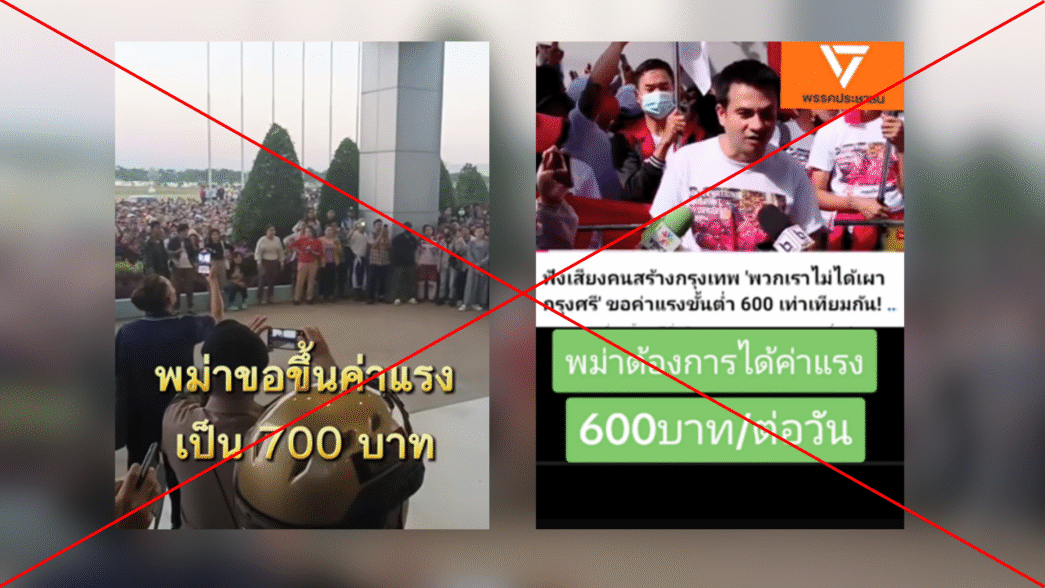
In addition to recycling the old clip out of context, some versions were edited to include the logo of the People’s Party, falsely implying that the party supported the alleged demand.
Under Thai law, both Thai and foreign workers are entitled to the same minimum wage. Claims that Myanmar workers in Thailand staged protests demanding a 700-baht daily wage are therefore misleading.
2. Does the ‘Ethnic Groups Act’ allow land distribution of 20 rai to foreigners?
In August, the Ethnic Groups Protection and Promotion of Ways of Life Act 2025, commonly referred to as the Ethnic Groups Act, was approved by Parliament. It marked Thailand’s first law aimed at promoting the rights of more than 80 ethnic groups in the country, such as the Karen, Moken, and the Kuy in the Northeast.
However, misleading claims circulated that the law would allow the government to “distribute land to foreign workers.”
The Ethnic Groups Act contains no provision whatsoever regarding the allocation of 20 rai of land. The claim appears to stem from a mistaken, whether intentional or not, association with a Royal Decree on Conservation and Management of Natural Resources within National Parks under Section 64 of the National Parks Act, commonly known as the Conservation Decree. This decree allows land allocation of up to 20 rai per household exclusively to Thai nationals who can prove continuous residence and land use.
The Conservation Decree, which came into effect on 16 November 2024, aims to address land-use conflicts between local communities and protected forest areas. These lands are often inhabited by ethnic communities. The law establishes strict procedures to prevent fraudulent claims or unlawful land appropriation.
Thailand is ethnically diverse. Many ethnic group members were born in Thailand and are entitled to Thai nationality. Some already possess national ID cards, while others—often living in remote mountainous areas—were missed in earlier surveys and are still undergoing civil registration processes. These groups are not the same as migrant workers from neighboring countries who have moved to Thailand in recent decades for employment. Thai law grants these groups different sets of rights, and conflating them leads to misunderstanding.
3. Do migrant workers have no right to protest?
News of labor protests by employees at Daikin Industries (Thailand) in Chonburi Province in early December highlighted the importance of workers’ right to collective action. Ultimately, the labor union and the company reached an agreement in line with workers’ demands.
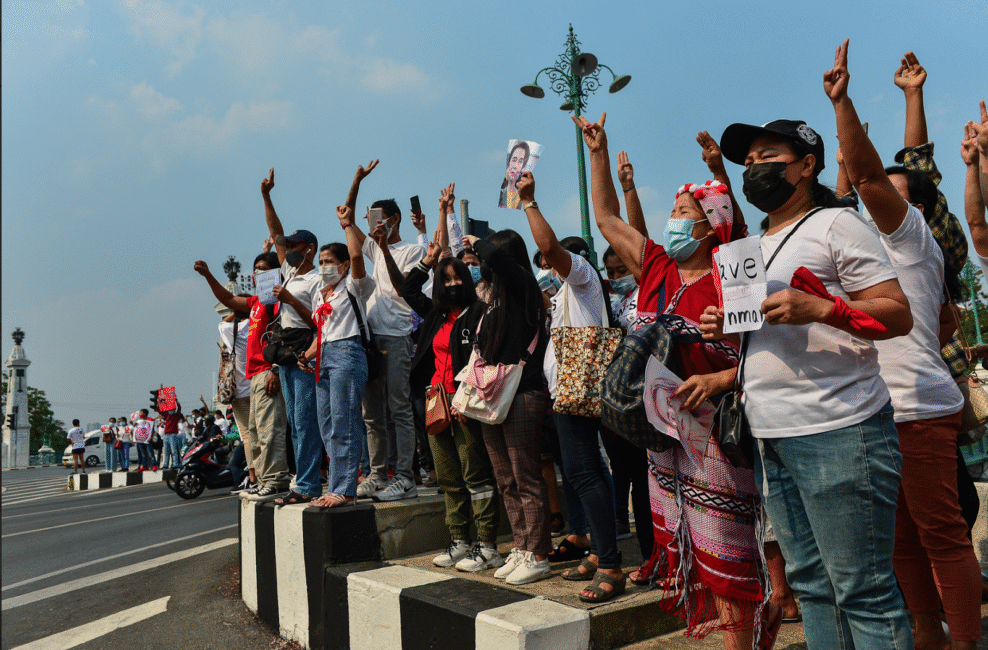
Thai citizens enjoy the right to peaceful assembly under international human rights principles and Thai law, with no blanket prohibition. However, when migrant workers assemble in Thailand, they are often perceived as being defiant or making excessive demands. Political demonstrations—such as protests by Myanmar nationals in Thailand against the military dictatorship in Myanmar—are often viewed as potentially damaging to Thailand’s relations with neighboring countries.
Some Thai social media users have even spread the false claim that “foreigners have no right to protest.”
For example, on 6 November 2025, the Facebook page “Tangdao Tham Arai” (“What Are Foreigners Doing?”) accused Myanmar labor leaders in Thailand of “lying to Myanmar workers by claiming they have the right to engage in political protests, even though the Ministry of Labor has not signed any convention permitting this.”
A review of relevant laws shows that three laws—the Constitution, the Public Assembly Act, and the Labor Relations Act—recognize the right to peaceful and unarmed assembly without restricting it to Thai citizens only.
Meanwhile, the Emergency Decree on the Management of Foreign Workers contains no explicit prohibition on assembly. However, if an assembly results in work stoppages, it may be interpreted as a violation of work permits or employment contracts, potentially leading to fines or deportation.
While Thailand does not directly prohibit migrant assemblies, there are legal constraints that may indirectly limit collective action. This is why human rights defenders and labor scholars in Thailand continue to advocate for Thailand to ratify ILO Convention No. 87 (Freedom of Association) and Convention No. 98 (Right to Collective Bargaining)—not only for the benefit of migrant workers, as someone who tries to mislead claimed, but for workers of all nationalities, including Thai workers.
Thai labor law guarantees equal treatment and welfare for Thai and migrant workers, such as equal pay and protection against workplace discrimination. In reality, however, many migrant workers still face discrimination, including being paid below the minimum wage. The ability to assemble is therefore a fundamental safeguard, enabling workers to collectively defend their rights when violations occur.
4. Are Thai taxpayers footing the medical bills for migrants?
The claim that Thai taxpayers bear the cost of healthcare for migrant workers was another widespread misconception in 2025, partly fueled by tensions surrounding the Thai–Cambodian conflict.
Today News interviewed Surasak Thanaisawanyangkoon, Advisor on Migrant Health Programs under the Thai government–World Health Organization cooperation framework. He reported that in 2024, 70% of migrant workers treated at public hospitals paid their medical expenses themselves. The remainder used other forms of coverage, such as social security or private health insurance.
Data from the Migrant Health Program shows 1,111 cases (0.09%) where migrants could only partially pay medical fees, and 4,351 cases (0.38%) where they could not pay at all. These figures align with information shared by healthcare workers on social media, who reported treating migrant patients unable to pay for care that doctors provided in accordance with medical ethics.
While gaps do exist in frontline practice and some migrants are unable to pay for healthcare, such cases represent a very small proportion of the overall migrant population. This is consistent with the Ministry of Public Health’s clarification correcting figures in the National Economic and Social Development Council’s fourth-quarter and annual social situation report for 2024. The ministry stated that unpaid medical expenses incurred by foreign populations average 2.5 billion baht per year across 31 provinces, not 92 billion baht as in the Office of the National Economic and Social Development Council (NESDC) report.
Thai authorities have a health insurance system for non-Thai populations. Therefore, they are entitled to receive medical treatment under the health insurance schemes available to them or may choose to pay medical expenses out of pocket. Highlighting the problems of only one group of migrant workers who are unable to pay medical costs and distorting or generalizing such cases leads to misunderstandings about both migrant workers and the management of relevant government agencies.
5. Is the Thai government opening the door for foreigners to obtain Thai citizenship?
In recent years, government policies promoting the rights of stateless persons and refugee children have been criticized by some groups as being a covert agenda by politicians to benefit “grey-area” foreigners. These criticisms have created misunderstandings about state measures or policies, such as claims that these measures would lead to granting Thai citizenship to newly arrived foreigners.
Policies that are often distorted and cause confusion include:
1) The Cabinet Resolution to expedite solutions to nationality issues (Cabinet Resolution dated 29 October 2024)
This Cabinet Resolution aims to resolve the long-standing problem of stateless persons that the Thai government has been addressing for several decades. The resolution applies to approximately 340,000 people who migrated to Thailand during the Cold War, the Indochina Wars, and conflicts in Myanmar. These individuals are eligible to apply for permanent residency in Thailand and, after residing in the country for five years, may apply for naturalization as Thai citizens. In addition, around 140,000 children born in Thailand to this group are entitled to Thai nationality under the principle of jus soli (right of the soil) as provided by law. These groups have already integrated into Thai society and contributed to the Thai economy.
In the past, there have been multiple Cabinet Resolutions recognizing the right to Thai nationality. However, due to the time-consuming nature of the process, combined with the loss of evidence and witnesses over time, the government issued this resolution to reduce processing time.
The key point is that this Cabinet Resolution does not grant Thai nationality to migrant workers or newly arrived refugees.
2) The withdrawal of Thailand’s reservation to Article 22 of the Convention on the Rights of the Child (CRC)
On 30 August 2024, Mr. Cherdchai Chaivaivid, Permanent Representative of Thailand to the United Nations in New York, submitted Thailand’s instrument of withdrawal of its reservation to Article 22 of the Convention on the Rights of the Child to the Head of the Treaty Section, Office of Legal Affairs of the United Nations, with immediate effect.
The Ministry of Foreign Affairs explained that Thailand became a party to the Convention on the Rights of the Child in 1992, at which time it entered several reservations. Thailand has gradually withdrawn these reservations over time. The withdrawal of the reservation to Article 22—concerning the protection of children seeking refugee status or recognized as refugees under applicable domestic or international laws or procedures—marks the withdrawal of Thailand’s final reservation to the Convention on the Rights of the Child. This action fulfills Thailand’s commitment announced at the second Global Refugee Forum in December 2023 in Geneva.
Meanwhile, the Department of Children and Youth stated that the withdrawal of the reservation to Article 22 of the Convention on the Rights of the Child will provide protection for two groups of children: more than 30,000 children fleeing armed conflict from Myanmar, and 1,800 children who have been screened under the Prime Minister’s Office Regulation on the Screening of Aliens Entering the Kingdom and Unable to Return to Their Country of Origin. These children will receive protection from abuse and exploitation in various forms, and will be facilitated in birth registration so that they have identity documents and access to basic rights. This measure does not grant Thai nationality.
Some people may worry that Thailand’s bureaucratic system has corruption loopholes that could allow foreigners to exploit these policies to apply for Thai nationality. In this regard, the Ministry of Interior has confirmed that there are strict and careful criteria for consideration, making such exploitation difficult. Moreover, preventing corruption requires enhanced oversight and the implementation of preventive measures, so that concerns about corruption do not obstruct the development of better public policies.
Note: This political fact-checking report is part of the project Information Integrity Towards Fact-Free Fair Elections in Thailand, jointly implemented by Cofact, Thai PBS Verify, and Thammasat University, with support from the German Embassy in Thailand.