❓ Claim Reviewed:The Constitution of the Kingdom of Thailand 2017 stipulates that corruption cases have no statute of limitations; defendants are prohibited from leaving the country; corruption is punishable by death; causing damage through national administration carries a prison sentence of 15–30 years; and officials on official travel are prohibited from flying First Class.
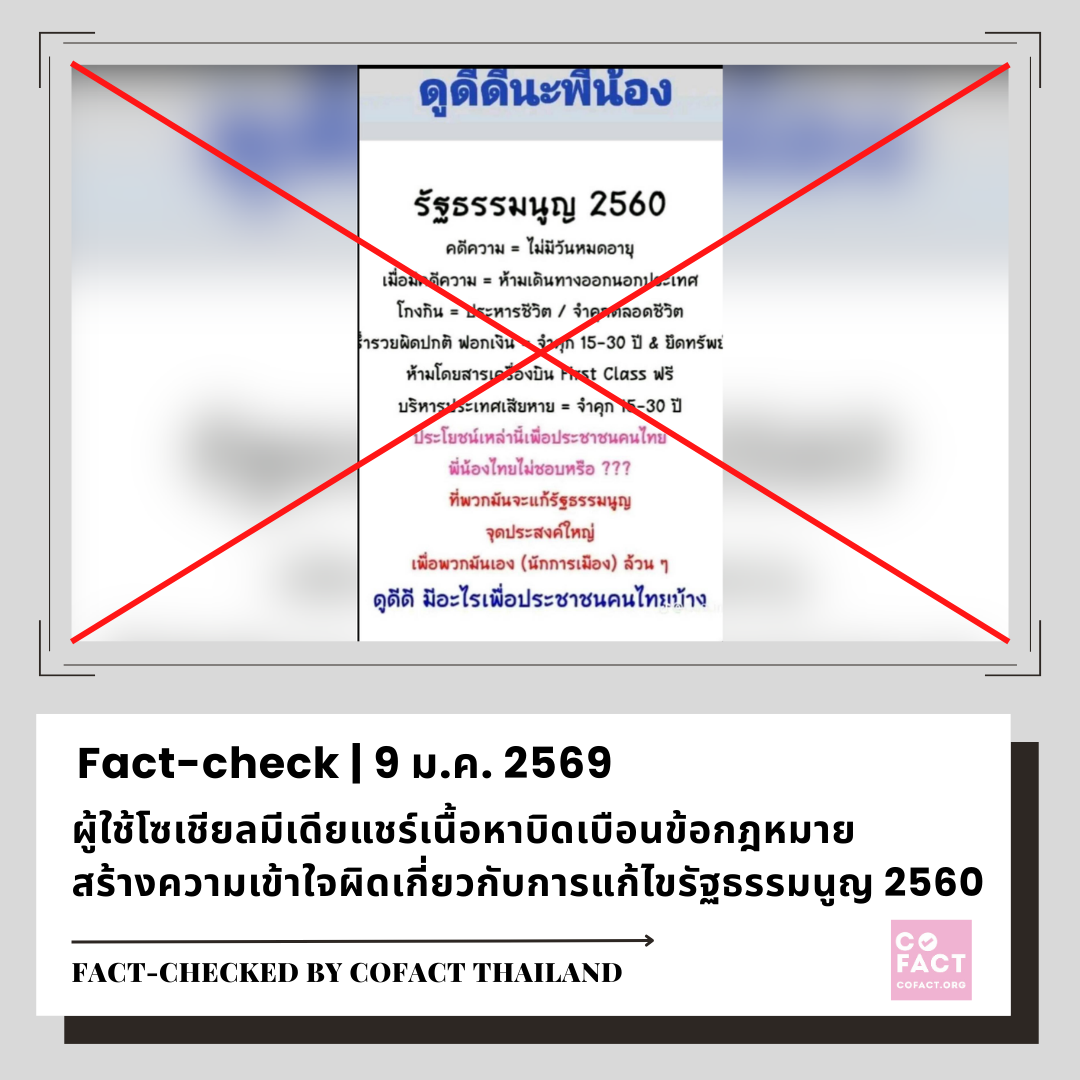
❓ Claim Reviewed:The Constitution of the Kingdom of Thailand 2017 stipulates that corruption cases have no statute of limitations; defendants are prohibited from leaving the country; corruption is punishable by death; causing damage through national administration carries a prison sentence of 15–30 years; and officials on official travel are prohibited from flying First Class.
❌ Fact-Check Result: Misleading Content
The claim misrepresents provisions from other laws as if they were provisions of The Constitution of the Kingdom of Thailand 2017
📝 Summary:
Between 4–8 January 2026, social media posts circulated claims regarding the content of the Constitution of the Kingdom of Thailand B.E. 2560 (2017), asserting that it contains strict anti-corruption provisions and accusing those who support constitutional amendments of attempting to protect politicians’ interests.
The circulated messages claimed that the 2017 Constitution provides that corruption cases never expire; defendants in corruption cases are prohibited from leaving the country; corruption is punishable by death or life imprisonment; unusual wealth and money laundering offenses are punishable by 15–30 years’ imprisonment with asset seizure; misadministration causing national damage is punishable by 15–30 years’ imprisonment; and political officeholders or civil servants are prohibited from flying First Class.
Social media pages and accounts that shared this content include the Facebook group “TOP NEWS THAILAND Fans” , and Facebook pages “The Critics” and “Economic Business News”.
🔎 Cofact’s Findings: The Constitution of the Kingdom of Thailand B.E. 2560(2017) contains no provisions, penalties, or prohibitions as claimed. These provisions appear instead in other laws, most of which predate the current Constitution.
▪ Corruption cases have no statute of limitations Section 7 of the Organic Act on Anti-Corruption B.E. 2561 (2018) provides that the period during which an accused or defendant absconds while criminal proceedings are pending shall not be counted as part of the statute of limitations. If a defendant absconds after a final judgment imposing punishment, the provisions on prescription under the Criminal Code shall not apply.
▪ Defendants are prohibited from leaving the country Section 108 of the Criminal Procedure Code, concerning provisional release, which predates the 2017 Constitution, provides that when a defendant applies for and is granted provisional release, the court may impose conditions to prevent flight, including a prohibition on leaving the country.
For corruption cases, Section 39 of the Organic Act on Anti-Corruption provides that relevant provisions of the Criminal Procedure Code concerning arrest, detention, and provisional release shall apply.
▪ Corruption is punishable by death or life imprisonment Sections 148, 149, 201, and 202 of the Criminal Code prescribe penalties of life imprisonment or death for offenses relating to malfeasance in official positions and offenses against the administration of justice.
Section 148 Whoever, to be the official, by a wrongful exercise of one’s functions, to coerce or to induce any person to deliver or to procure the property or any other benefit for oneself or other person, shall be imprisoned as from five years to twenty years or to life imprisonment, and fined as from two thousand Baht to forty thousand Baht, or both.
Section 149 Whoever, being an official, member of the State legislative Assembly, member of the Changwat Assembly or member of the Municipal Assembly, wrongfully demands, accepts or agrees to accept for himself or the other person a property or any other benefit for exercising or not exercising any of his functions, whether such exercise or non-exercise of his functions is wrongful or not, shall be punished with imprisonment of five to twenty years or imprisonment for life, and fined of two thousand to forty thousand Baht, or death.
Section 201 Whoever, to be the official in the judicial post, Public Prosecutor, official conducting the cases or the inquiry official, wrongfully to demand, accept or agree to accept the property or any other benefit for oneself or the other person so as to exercise or non-exercise any act, whether such exercise or non-exercise wrongfully oneself’s function or not, shall be imprisoned as from five years to twenty years or life imprisonment and fined as from two thousand Baht to forty thousand Baht, or death.
Section 202 Whoever, being an official in a judicial post, a Public Prosecutor, an official conducting cases or an inquiry official, exercises or does not exercise any of his functions in consideration of a property or any other benefit which he has demanded, accepted or agreed to accept before his appointment to such post, shall be punished with imprisonment of five to twenty years or imprisonment for life, and fined of two thousand to forty thousand Baht, or death.
Organic Act on Anti-Corruption B.E 2561(2018). Life imprisonment appears in Sections 173 and 174 provide that a state official who wrongfully demands, accepts, or agrees to accept property or any other benefit shall be punishable by imprisonment for a term of five to twenty years or life imprisonment.
Section 173 A public official, foreign public official or official of an international organisation who requests, accepts, or agrees to accept any assets or other benefits for himself or herself or other person in order to act or omit an act in position, regardless of whether such act is legitimate or illegitimate towards the duty, shall be liable to imprisonment for a term of five to twenty years or life imprisonment and to a fine of one hundred thousand Baht to four hundred thousand Baht.
Section 174 Any public official, foreign public official or official of an international organisation who performs or omits to perform an act in position with the intention to obtain the assets or other benefits which he or she requests, accepts, or agrees to accept before taking office shall be liable to imprisonment for a term of five to twenty years or life imprisonment and to a fine of one hundred thousand Baht to four hundred thousand Baht.
Sections 234–236 of the 2017 Constitution specify the powers and duties of the National Anti-Corruption Commission (NACC) and procedures concerning unusual wealth, but do not prescribe penalties.
Criminal penalties derive from other relevant laws, such as offenses relating to official misconduct under the Criminal Code, or offenses of concealing assets or submitting false asset declarations under Section 167 of the Organic Act on Anti-Corruption, punishable by imprisonment of up to six months.
For money laundering offenses, Section 60 of the Anti-Money Laundering Act B.E. 2542 (1999) provides for imprisonment from one to ten years, or a fine from 20,000 to 200,000 baht, or both.
▪ Misadministration causing damage punishable by 15–30 years’ imprisonment
No such penalty exists in the 2017 Constitution. Relevant provisions are found in Section 157 of the Criminal Code and Section 172 of the Organic Act on Anti-Corruption, both prescribing imprisonment from one to ten years.
A notable case is the rice-pledging case involving former Prime Minister Yingluck Shinawatra. On 27 September 2017, the Supreme Court’s Criminal Division for Holders of Political Positions ruled that she was guilty under Section 157 of the Criminal Code and the Organic Act on Anti-Corruption for failing to investigate and prevent corruption, sentencing her to five years’ imprisonment.
▪ Prohibition on flying First Class for officials
This prohibition does not appear in the 2017 Constitution. Relevant provisions are found in the Royal Decree on Official Travel Expenses (No. 9) B.E. 2560 (2017), Section 53, which specifies categories of officials permitted to fly First Class on official international travel, including heads of government delegations, parliamentary leaders, ministers, and top-level officials.
Section 53/1 further provides that for international flights of nine hours or more, additional senior officials and high-ranking military and police officers may fly First Class.
📌 Cofact’s Observation:
The dissemination of misleading information opposing amendments to the 2017 Constitution has occurred for some time, but has resurged during the countdown to the referendum on drafting a new constitution scheduled for 8 February 2026. This misinformation creates the false impression that constitutional amendments would eliminate anti-corruption provisions and penalties, potentially influencing public opinion against constitutional reform and casting doubt on the intent behind such amendments.