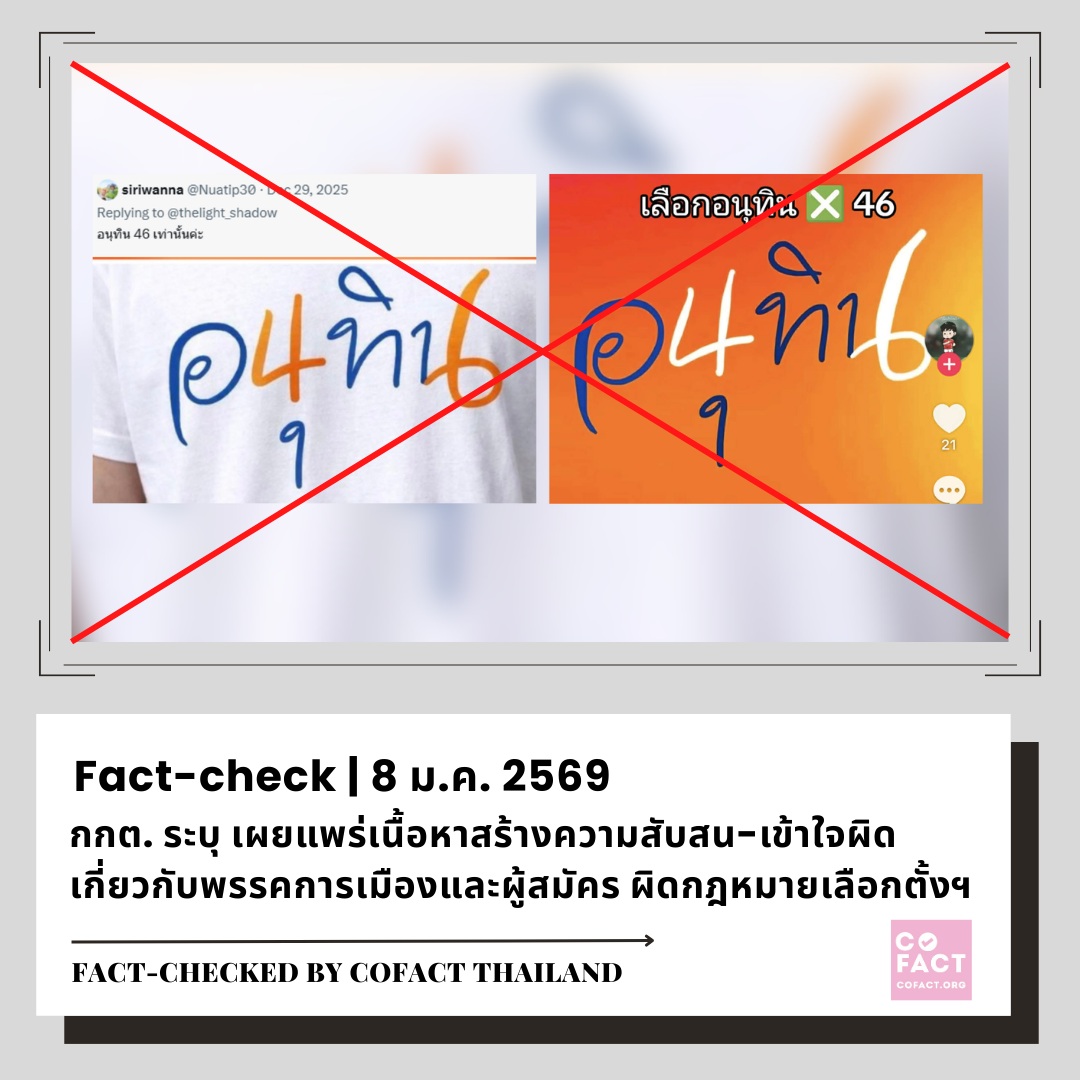
❓ Claim checked: Vote for Anutin–Bhumjaithai, mark number 46.
❌ Fact-check result: False content
📝 Summary of the content:
After the drawing of party numbers for the party-list MP election or “party number” on 28 December 2025, a number of social media users shared humorous and satirical images and messages claiming that if voters want Anutin Charnvirakul to become prime minister in the 8 February 2026 election, they should mark number 46 on the party-list ballot.
For example, one Facebook user posted: “If you want Anutin to be prime minister, mark number 46,” along with an image of a T-shirt printed with the number 46 subtly embedded in the name “Anutin.” Another X user posted the same image with the caption: “Anutin, only 46.”
🔎 Cofact’s verification:
According to the official announcement of the Election Commission (EC), the party-list number of the Bhumjaithai Party is 37, while number 46 belongs to the People’s Party.
The spread of this false content may have been intended as a joke or satire, or to mock the People’s Party for allegedly supporting Anutin as prime minister. Although many such posts have already been deleted, several remain accessible on Facebook, TikTok, and X.
Thanthap Paramee, Director of Legal Division 1, Office of Legal Affairs and Litigation, Election Commission—who oversees election offenses and prohibited campaign practices—told Cofact that disseminating content of this nature could constitute deception, defamation, or misleading inducement regarding a political party or candidate, which is an offense under Section 73(5) of the Organic Act on the Election of Members of the House of Representatives.
Section 73(5) No candidate or any person shall engage in any act intended to induce eligible voters to vote for themselves or for another candidate, to refrain from voting for any candidate, or to persuade voters to cast a vote for “no candidate,” by means of deception, coercion, threats, intimidation through the use of influence, false defamation, or by misleading voters regarding the popularity of a candidate or a political party.
The EC’s legal director further explained that anyone who encounters such conduct may notify the EC to investigate and order the removal or correction of the information. Even if the offender is an ordinary citizen who is not an MP candidate or affiliated with a political party, the EC can still pursue legal action, because the law states that “candidates or any person” are prohibited from such actions.
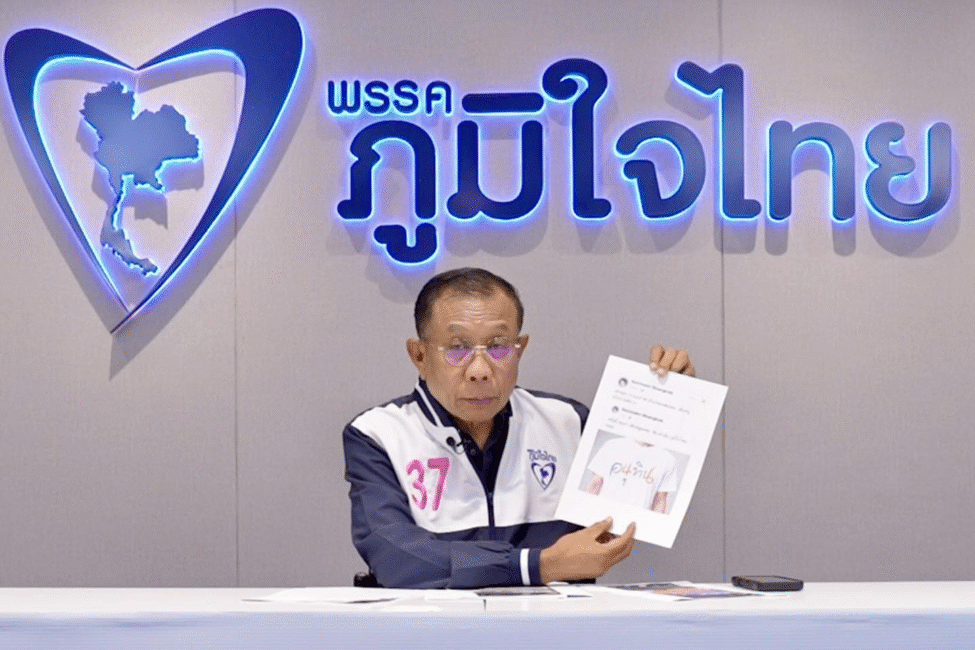
On 7 January, Supachai Jaisamut, a party-list MP candidate of the Bhumjaithai Party, announced at a press conference that the party would file a criminal complaint with investigators of the Technology Crime Suppression Division to take legal action against those spreading false information that confuses voters. The party would also submit a complaint to the EC regarding the People’s Party, as Bhumjaithai believes it directly benefited from the misleading content but failed to stop or prevent its dissemination—an act that may fall under Section 132 of the Organic Act on MP Elections.
Section 132 grants the EC authority to order a political party that benefits from actions undermining the fairness of an election to halt or correct such actions. If the party fails to comply with the EC’s order without valid reason, it shall be presumed that the party was complicit, unless it can prove otherwise.