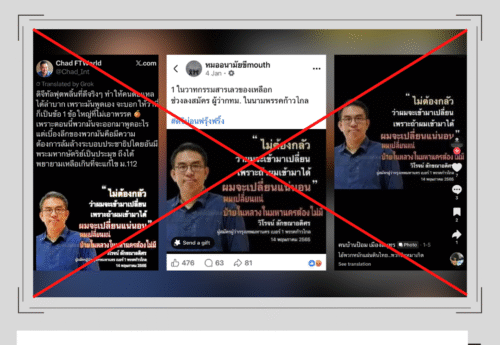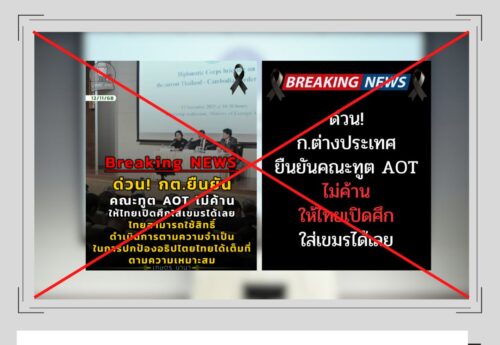
Social media accounts aligned with opponents of the People’s Party have spread misleading information about the management of donations and state subsidies when a political party is dissolved.
.
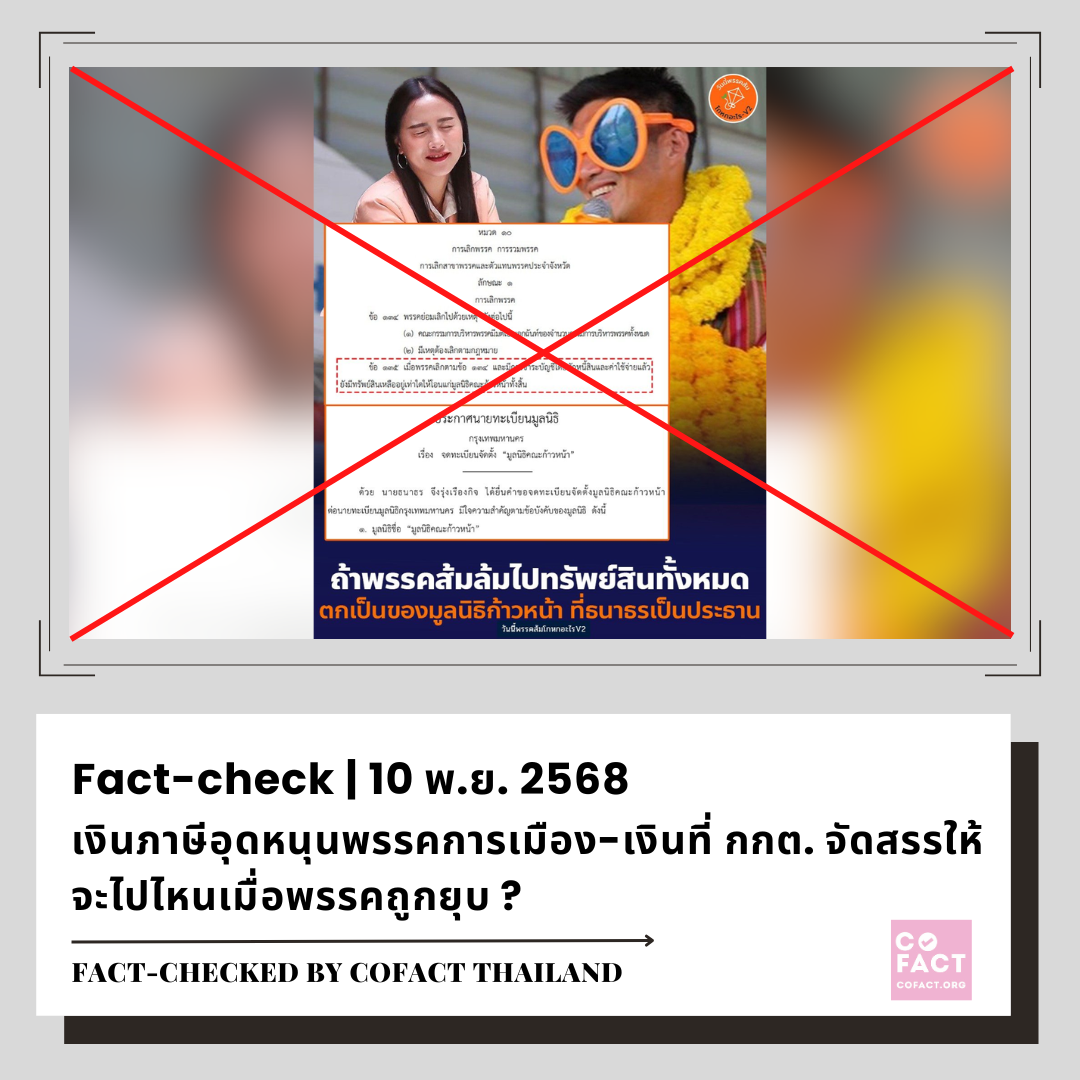
Social media accounts aligned with opponents of the People’s Party have spread misleading information about the management of donations and state subsidies when a political party is dissolved. They claim that if the People’s Party is dissolved, taxpayer money used to support political parties and funds allocated by the Election Commission (EC) would be transferred to the Progressive Movement Foundation, of which Thanathorn Juangroongruangkit is a chairman.
Cofact reviewed the relevant laws and interviewed EC officials, finding that when a political party is dissolved or ceases operations, taxpayer funds used to support political parties and any remaining funds from the Political Party Development Fund allocated by the EC—after liquidation—must be returned to the fund. They are not transferred to public charitable organizations. Only a party’s own assets may be transferred to a public charitable organization specified in that party’s regulations.
The spread of such misleading information about the management of a political party’s income after dissolution not only harms a particular party but also creates misunderstandings about the Organic Act on Political Parties and the operations of the Political Party Development Fund under the EC’s supervision, ultimately undermining confidence and trust in the political party system as a whole.
Full report
Social media accounts aligned with opponents of the People’s Party have disseminated disinformation regarding the handling of donations and state subsidies when a political party is dissolved. The claims allege that if the People’s Party were to be dissolved, taxpayer-funded subsidies and funds allocated by the Election Commission of Thailand (ECT) would be transferred to the Progressive Movement Foundation, chaired by Thanathorn Juangroongruangkit.
Cofact examined the relevant legal provisions and interviewed officials from the Office of the Election Commission of Thailand (ECT). The findings confirm that when a political party is dissolved or ceases operations, public subsidies and funds allocated from the Political Party Development Fund must be returned to the Fund. Such funds are not transferred to public charitable organizations.
Content examined On 22 October 2025, the Facebook page “วันนี้พรรคส้มโกหกอะไร V2” posted a message stating “#Everyone, if the Orange Party is shut down or dissolved, the money and assets that the public and taxpayer funds allocated by the ECT to the Orange Party will be transferred to the ‘Progressive Movement Foundation, which has Thanathorn Juangroongruangkit as its chairperson.”
The accompanying image featured photographs of Rukchanok Srinork, a Bangkok member of parliament from the People’s Party, and Thanathorn Juangroongruangkit, Chair of the Progressive Movement Foundation. It also displayed excerpts from the People’s Party regulations, stating “When the party is dissolved under Section 134, and liquidation has been completed, after deducting liabilities and expenses, any remaining assets shall be transferred in their entirety to the Progressive Movement Foundation.”
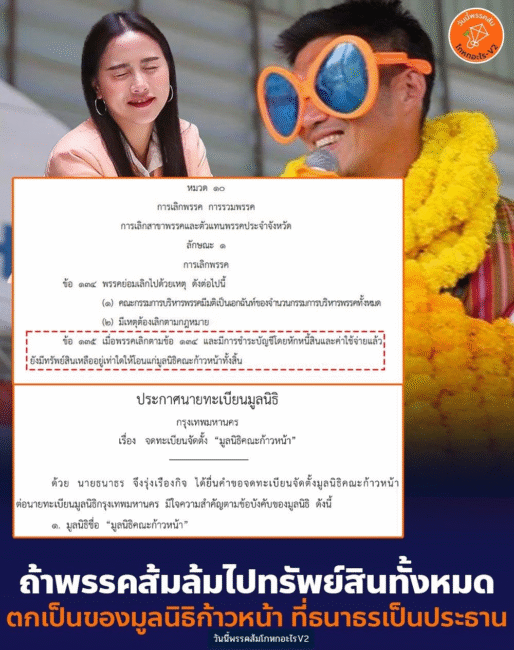
The image further included the official registration announcement of the Progressive Movement Foundation, listing Thanathorn as the applicant for its establishment. At the bottom, the image carried the caption:
“If the Orange Party collapses, all assets will belong to the Progressive Movement Foundation, chaired by Thanathorn.”
This post was shared more than 500 times, and similar content was reposted on the X (Twitter) account “วันนี้พรรคส้มโกหกอะไร” around the same period.
On 23 October, the Facebook page “The METTAD” posted similar content by sharing a video clip from a public forum titled “Why Must Local Governance Be Unlocked?”, organized by the Progressive Movement at Songklanakarin University, Pattani Campus, on 25 June 2022. During one segment of the event, a member of the audience stood up to express the view that people in the southern border provinces should be able to determine their own future, including the issue of independence.
The Facebook page The METTAD republished this clip and added the following caption: “According to the party’s regulations, if the Orange Party is dissolved, all donations will be transferred to the Progressive Movement Foundation. The Progressive Movement Foundation will then use the money to carry out activities like this. I would like to ask whether supporting a separatist movement aligns with the intentions of the donors.”
These posts were circulated about one week after Rukchanok, an MP from the People’s Party, raised questions regarding transparency in fundraising and financial management by the Kan Jom Palang Chuai Su Foundation. This led to the disclosure of the foundation’s regulations, which state that if the foundation ceases operations, “all remaining assets of the foundation shall become the property of the Thammanat Prompao Foundation.”
Cofact conducted a fact check of the Organic Act on Political Parties 2017. The Act stipulates that political parties may have income from the following sources:
- seed capital from party registration,
- membership fees and party dues as specified in party regulations,
- income from the sale of goods or services of the party,
- money, assets, and other benefits obtained from party fundraising activities,
- money, assets, and other benefits received as donations,
- subsidies from the Political Party Development Fund, and
- interest and other income derived from the party’s money, assets, or other benefits.
Content published on the pages “วันนี้พรรคส้มโกหกอะไร V2” and The METTAD stated that “money and assets from the public and taxes allocated by the Election Commission of Thailand (ECT) to the Orange Party” and “all donations” would be transferred elsewhere. These statements can be interpreted as referring to two categories of political party income: (1) donations from the public, and (2) funds allocated to political parties by the ECT. The pages claimed that if the party were dissolved, these funds would become the property of the Progressive Movement Foundation.
Cofact verified the facts by examining the Organic Act on Political Parties and by interviewing a senior official from the Office of the Political Party Development Fund Administration of the Election Commission. The findings are as follows:
1) Donations from the public to political parties
Under the Organic Act on Political Parties, public support for political parties consists of two forms:
- Tax allocation support for political parties under Section 69. This refers to a system whereby individual income taxpayers (who are not juristic persons) may express their intention in their annual personal income tax return to allocate 500 baht per year of the taxes they have already paid to a political party of their choice. Taxpayers do not pay additional money; the amount is deducted from the taxes they would otherwise remit to the Revenue Department.
- Donations made by individuals or juristic persons to political parties under Section 70. Donors are entitled to claim tax deductions for the donated amount, up to 10,000 baht for individuals and up to 50,000 baht for juristic persons.
2) Funds allocated by the Election Commission to political parties
Funds allocated by the EC to political parties come from the Political Party Development Fund under Section 78 of the Organic Act on Political Parties. This fund is intended to serve as working capital and to finance activities that support political parties, promote public participation, and strengthen political parties as democratic institutions representing citizens who share common political ideals.
Officials from the Office of the Political Party Development Fund Administration stated that the fund’s resources come from multiple sources, including:
- tax allocation funds under Section 69 are transferred from the Revenue Department (which the ECT must then allocate to political parties according to the actual amounts designated by taxpayers),
- annual budget appropriations,
- candidate application fees,
- money and interest recovered from political parties or politicians who violate election laws, and
- remaining assets after the liquidation of dissolved or defunct political parties, which have no provisions requiring such funds to be donated to any foundation.
The Fund Committee, chaired by the President of the Election Commission and comprising election commissioners, representatives from the Ministry of Finance and the Bureau of the Budget, and two qualified experts, oversees the fund and allocates financial support to political parties in accordance with criteria set out in the Organic Act. Any political party wishing to use funds from the Political Party Development Fund must submit a project proposal for approval by the Fund Committee.
The annual guideline on the allocation and use of subsidies from the Political Party Development Fund 2024 specifies that the ECT approves the funding amount and transfers subsidies to political parties via designated Krung Thai Bank accounts. Parties may disburse funds annually, strictly in accordance with ECT regulations, and must issue receipts and submit expenditure reports to the EC every three months.
Pannika Wanich, a board member of the Progressive Movement Foundation, told Cofact that many people mistakenly believe that funds from the Political Party Development Fund are automatically transferred into political party bank accounts. In reality, parties must submit proposals for approval, and whether funds are granted depends entirely on the Fund Committee’s consideration.
3) Where does the money go when a party is dissolved or ceases operations?
Officials from the Office of the Political Party Development Fund Administration explained that at the end of each year, political parties must return any unused funds from the Political Party Development Fund. In cases where a political party is dissolved or ceases operations, the Fund Committee will notify the State Audit Office (SAO) to conduct liquidation.
The SAO uses the funds previously transferred to the party to settle outstanding debts and expenses. After liquidation is completed, any remaining funds are returned to the Political Party Development Fund.
“Therefore, when a political party is dissolved or ceases to exist, every baht transferred from the Fund is returned to the Fund. No portion is transferred to any foundation or other organization, except for assets that belong to the political party itself and are unrelated to the Fund. Funds derived from tax allocation support are not the property of political parties, as the law designates them as revenue of the Political Party Development Fund. Political parties must return such funds to the Fund,” an official stated.
Regarding the liquidation of political parties that have ceased to exist or have been dissolved, ECT stipulates in the Manual on Finance and Accounting of Political Parties that the process can be summarized as follows:
• The party leader must submit the accounts, financial statements showing the financial position, as well as all financial-related documents of the political party, within 30 days from the date the party ceases to exist or is dissolved. The Office of the Auditor General (OAG) must complete the liquidation within 180 days.
• The OAG is empowered to spend the party’s funds or dispose of the party’s assets in order to obtain money to cover expenses incurred in the liquidation process.
• After deducting liabilities and expenses, any remaining assets shall be transferred to a charitable organization as specified in the party’s regulations. If no such organization is specified in the regulations, the remaining assets shall vest in the Political Party Development Fund.
• For political parties that have received subsidies from the Political Party Development Fund, the party leader or members of the party’s executive committee must return any remaining subsidy funds, together with any interest required to be repaid, to the Political Party Development Fund. Such amounts must be recorded in the accounts as liabilities, and the return of the remaining subsidy funds together with interest must be expedited prior to the publication in the Royal Gazette announcing that the political party has ceased to exist.
Cofact’s conclusion
The regulations of the People’s Party do indeed state that if the party ceases operations and, after liquidation and settlement of debts and expenses, any assets remain, those assets shall be transferred to the Progressive Movement Foundation, whose current chair is Thanathorn Juangroongruangkit.
However, the statements made by the Facebook page and X account “What Did the Orange Party Lie About Today?” and The METTAD—claiming that “money and assets from the public and taxes allocated by the EC to the Orange Party” or that “all donations” would be transferred to the Progressive Movement Foundation if the party were dissolved—are misleading. They create the false impression that tax allocation funds and subsidies from the Political Party Development Fund would be transferred to the Foundation.
Based on the Organic Act on Political Parties, the allocation and spending guidelines of the Political Party Development Fund, the financial and accounting manual for political parties, and interviews with ECT officials, Cofact concludes that tax allocation funds are classified as revenue of the Political Party Development Fund. When a political party is dissolved or ceases operations, any funds allocated from the Fund are used to settle debts and expenses, and any remaining balance must be returned to the Fund.
Only the political party’s own assets—such as seed capital, membership fees, income from merchandise or services, and proceeds from fundraising activities—may be transferred to the Progressive Movement Foundation as specified in the party’s regulations.
Notably, the content in question uses vague terms such as “donations” or “money and assets from the public,” which may intentionally lead readers to believe that these include tax allocation funds designated by taxpayers in their annual income tax filings. In reality, such funds are managed by the Political Party Development Fund and must be returned to the Fund upon dissolution or liquidation.
The dissemination of misleading information regarding the handling of political party finances after dissolution not only damages the People’s Party but also distorts public understanding of the Organic Act on Political Parties and the operation of the Political Party Development Fund. This may ultimately undermine public trust and confidence in the political party system.