Distorted Words and Fabricated Quotes: Traditional Disinformation Thriving in the AI Era
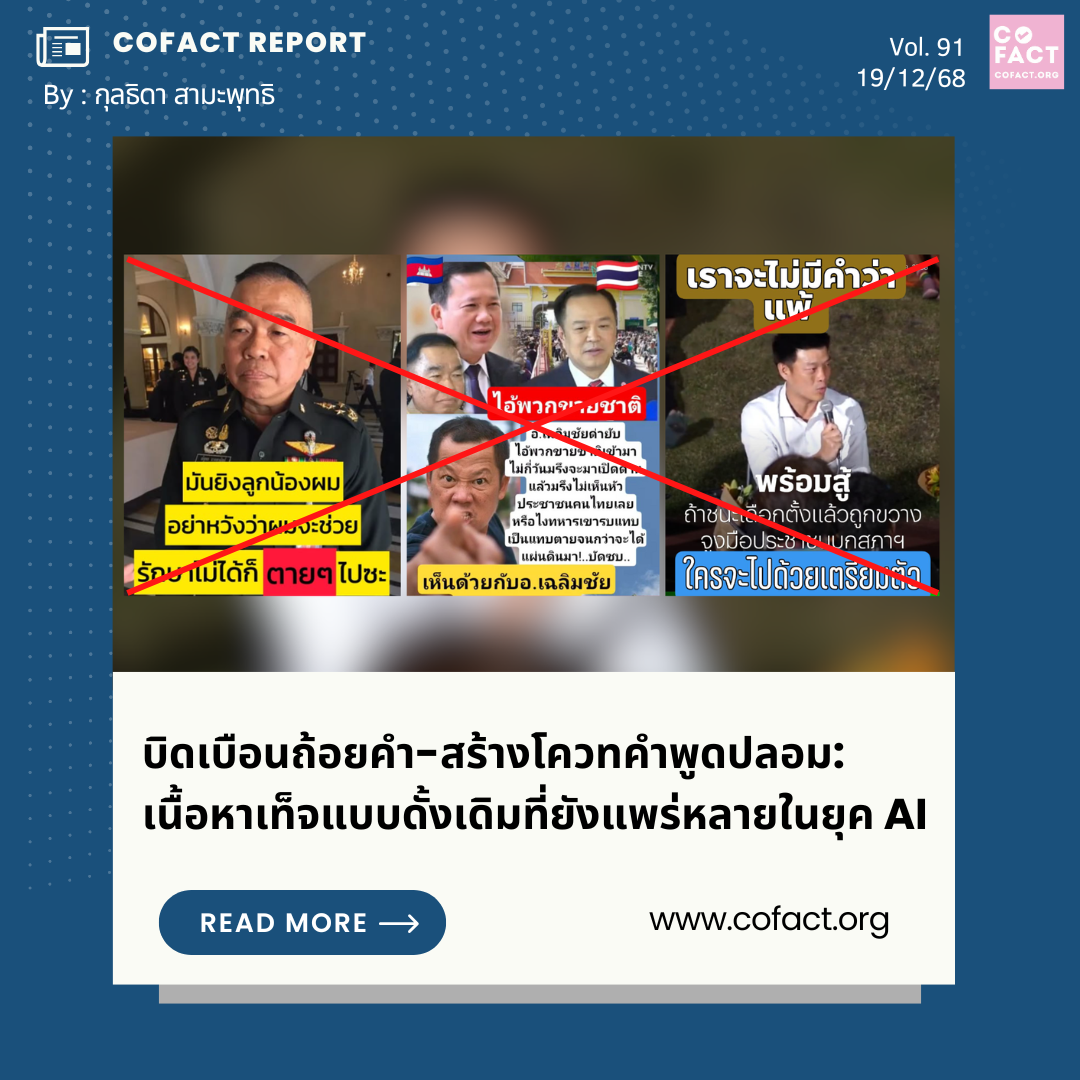
While many people are increasingly concerned about the spread of AI-generated misinformation especially during sensitive situations such as the Thai–Cambodian military conflict, natural disasters, and elections traditional forms of false content continue to circulate widely. These include misattributed statements and entirely fabricated quotes, which are used for various purposes ranging from emotional manipulation and boosting engagement to spreading misunderstanding and attacking political opponents.
Fake Quotes During the First Round of the Thai–Cambodian Conflict
During the first round of military clashes between Thailand and Cambodia from July 24 to 28, 2025, Cofact Thailand identified at least two instances in which false quotes were attributed to public figures.
On July 30, the Facebook page “HotNews – ข่าวประเทศไทย” posted an image of Gen Natthapon Nakpanich, then Deputy Minister of Defence, along with a caption claiming he angrily responded to reporters by saying: “Cambodians and Thais are not my relatives. If they die, let them die. Don’t expect me to help.”
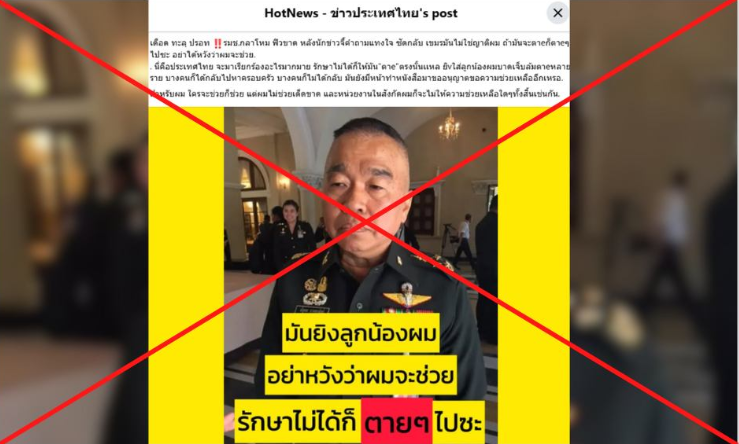
The image also contained embedded text reinforcing the impression that this was Gen. Natthapon’s actual statement. As of the date of verification, the post had been shared more than 2,400 times and was further disseminated on Instagram and TikTok.
However, Cofact reviewed video clips and news reports of Gen. Natthapon’s media interview following the Defence Council meeting on July 30 and found no such remarks. The only relevant comment he made was in response to a question about whether Thailand and Cambodia could return to being good neighbors. He replied that they could, but that military assistance would be temporarily suspended until tensions eased.
On July 31, the Ministry of Defence’s spokesperson officially clarified via Facebook that the viral post was false, stating that Gen. Natthapon had never made the remarks attributed to him online.
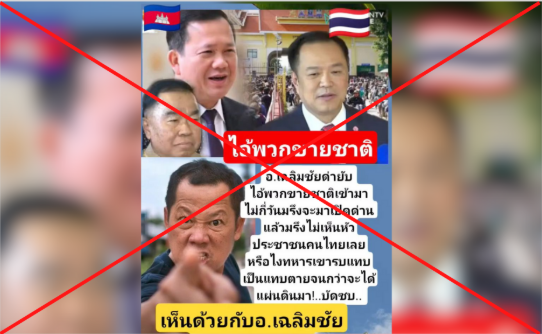
Another case involved a fabricated quote attributed to Chalermchai Kositpipat, a renowned Thai artist, falsely accusing then-Prime Minister Anutin Charnvirakul and Gen. Natthapon of proposing the reopening of Thai–Cambodian border checkpoints and harshly condemning them.
Between September 14–15, social media users shared images of Chalermchai with embedded text criticizing the reopening of border crossings, calling those who supported the move “traitors” who disregarded Thai soldiers’ sacrifices. Images of Anutin and Gen. Natthapol were included, along with the phrase “Agreed with Ajarn Chalermchai,” implying endorsement.
Chalermchai later categorically denied the statements in a video clip, stressing that he had never commented on border policy and reiterating that he does not involve himself in politics. He also noted that he had repeatedly been falsely quoted in political contexts.
Fake Political Quotes
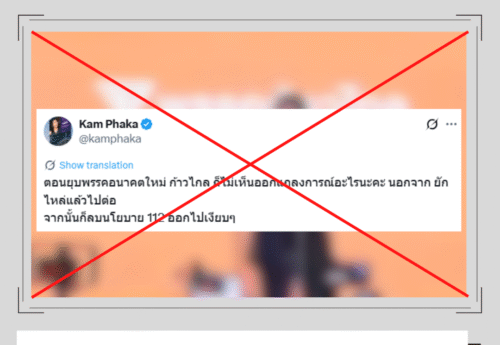
More recently, Cofact examined multiple posts from a Facebook account named Por Jasmine Hakinn Thuapai (พ่อจัสมิน หากินทั่วไป) , which has more than 90,000 followers. The account published several posts falsely attributing statements to Natthaphong Ruengpanyawut, leader of People’s Party.
On December 15, one post the image of Natthaphong embedded a message “Teng, Natthaphong Ruengpanyawut , rallies People’s Party supporter, saying that if electoral victory is obstructed, it will be time to fight, and signals readiness to storm Parliament.”
Another in the same day this facebook page post a massage “There will be no such thing as defeat. We are ready to fight. If we win the election and are then obstructed, we will join hands with the people and storm Parliament. Anyone who wants to go, get ready.” with Nattapong image making it appear as though the statement was spoken by him.
These posts used images from a real event titled “People’s Party Meets the People: A Sincere Apology and Moving Forward Together,” held at Srinakharinwirot University on December 13 and livestreamed on the party’s official Facebook page.
Cofact reviewed Natthaphong’s actual remarks at the event. During one session of the event, Nattaphong responded to a question about what the party would do if it won a majority in the 2026 election but was still unable to form a government, The leader of People’s Party said“If in the next election we can win the support of the majority of the people and secure more than half of the seats in parliament, I still cannot see, given the current situation, what could realistically hold People’s Party back from entering government and bringing about real change.
Some friends have asked: if we truly obtain more than half of the seats but still do not get to form the government, what obstacles might come and knock us down again? We have talked about this seriously within the party. If it really comes to that point, we would link arms and go to the front of parliament. If it reaches that extent, there would be no other option but to fight.”
When Nattaphong’s remarks are compared with the statements in the two posts from the Facebook page “Por Jasmine Hakinn Thuapai,” it is found that Nattaphong did in fact refer to a scenario in which People’s Party does not form the government despite winning a majority of seats in parliament in the 2026 election. If the situation were to reach that point, the leader of People’s Party stated that he had considered mobilizing outside Parliament.
However, the Facebook posts altered his wording to make it more aggressive, introducing terms such as “storm parliament,” and adding statements like “we will never accept defeat” and “whoever is coming, get ready.”
Cofact also found several other posts between December 11–15 using Natthaphong’s image alongside fabricated quotes implying it was Natthaphong’s remark. For examples
“If things do not go my way, I will not allow anyone to hold power.”
After reviewing credible news reports, parliamentary records, and public statements, Cofact found no evidence that Natthaphong had ever made such remarks. People’s Party confirmed that all the quoted statements were false. Natthaphong himself stated:
“I have never spoken or communicated in this manner,”
and questioned the intent behind the dissemination of such misinformation.

Cofact’s Observations
The distortion or fabrication of quotes attributed to politicians or public figures remains a common form of disinformation. Such content is often designed to attack political opponents or generate high engagement on social media.
Fake quotes typically use inflammatory language, provoke anger or hatred, and promote extreme ideas. Upon closer inspection, they often appear uncharacteristic or implausible for individuals holding public office.
These fabricated statements are frequently tied to current, high-interest events and are often paired with real images or videos. In some cases, logos of reputable news organizations are used to enhance credibility, making such misinformation more convincing.
Over the past one to two years, the widespread use of AI tools has further complicated fact-checking efforts. Cofact has observed increasing use of AI-generated images and audio impersonating real individuals, making it even harder to distinguish fact from fiction.
How to Verify Suspected Fake Quotes
To determine whether a quote is genuine, users can search for the statement or parts of it on Google to see whether it appears in reports from at least two credible news organizations.It is therefore possible that the statement is true.
If the quote specifies a date and location, checking video or audio recordings from that event can help verify authenticity.
For public figures with official communication channels, direct inquiries via verified social media accounts may also be effective.
However, if verification is not immediately possible, users are encouraged to refrain from sharing suspicious content to avoid unintentionally spreading misinformation.