Cofact examined four pieces of false content that Angkhana has faced over the past three weeks
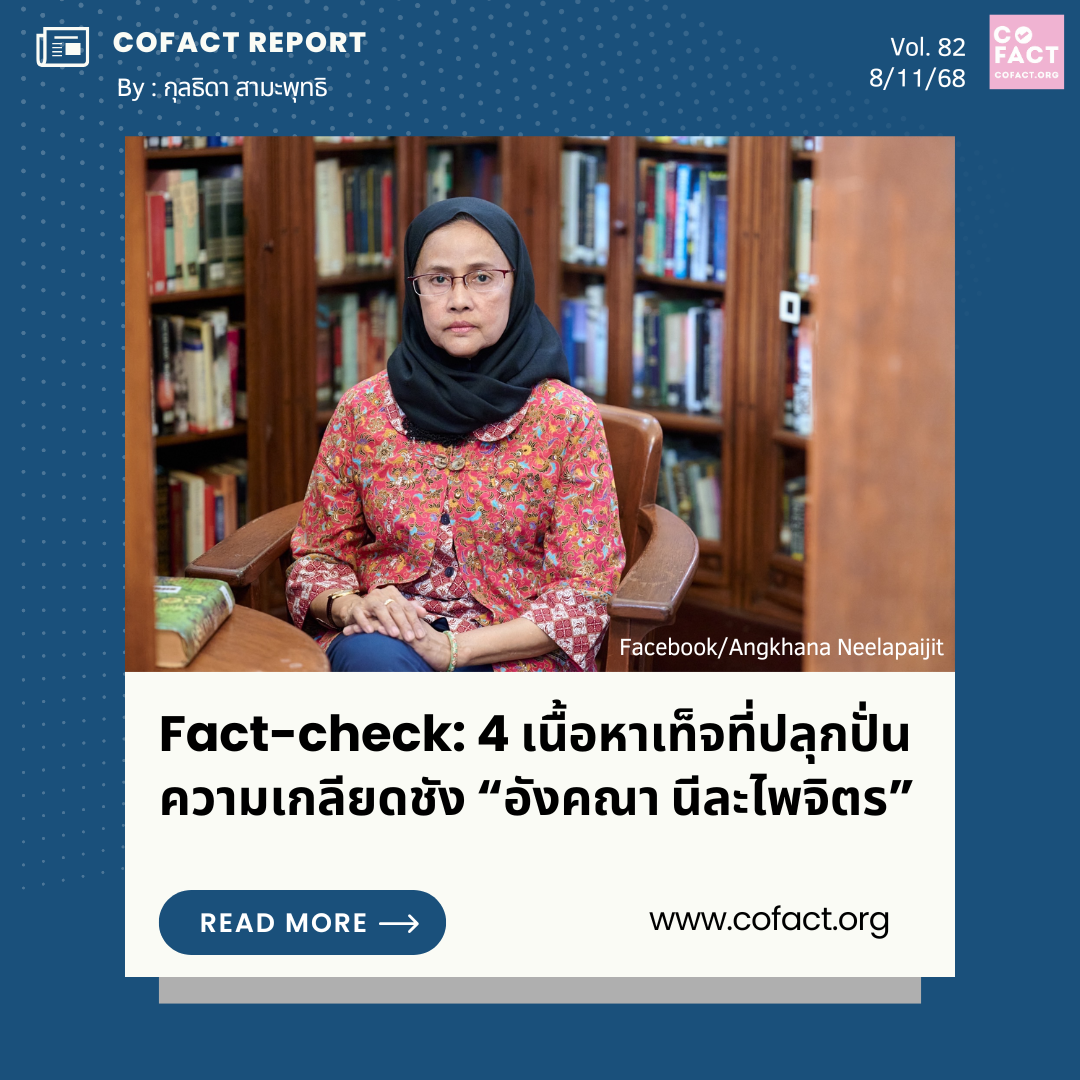
For more than 20 years, Angkhana Neelapaijit has worked to defend human rights. Hate campaigns, including verbal abuse and false information, have continuously targeted her.
‘When she spoke out about the Thai–Cambodian conflict in early October 2025, Angkhana was attacked once again. Although it was not the first time, she had never become accustomed to it. This time, the psychological impact was even more severe, as it represents repeated and ongoing trauma.
Cofact examined four pieces of false content that Angkhana has faced over the past three weeks, including the distortion of her statements, the spread of false information about Somchai Neelapaijit—her husband, who was forcibly disappeared 21 years ago—and the falsification of her biography on Wikipedia. The investigation illustrates how false content is used as a tool to incite anger and hatred against individuals.
Full report
After Angkhana Neelapaijit, a Senator and human rights defender, posted on Facebook on 12 October 2025 expressing concern over Cambodia’s submission of a letter to the United Nations alleging that Thailand broadcast eerie, wailing sounds through large loudspeakers late at night to disturb Cambodian villagers, she became the target of hate campaigns. These attacks involved both abusive language and disinformation, spread by social media users and some media outlets.
Cofact investigated four pieces of disinformation that Angkhana has faced over the past three weeks. These include recurring false narratives that have caused long-term harm to her and the Neelapaijit family for many years, as well as newly created content in the context of the Thai–Cambodian conflict, designed to incite hatred against human rights defenders.
1) Distortion of a Facebook post about “haunting sounds” and a statement regarding “F-16s.”
● Distortion of the Facebook post
On 12 October 2025, Angkhana posted on Facebook under the account “Angkhana Neelapaijit.” The main content was a translation of a complaint letter sent by the Chair of the Cambodian Human Rights Committee to the United Nations High Commissioner for Human Rights on 11 October 2025. The translated text stated:
“…Units of the Royal Thai Armed Forces broadcast sounds resembling ghostly wailing through large loudspeakers from 10:44 p.m. until 12:04 a.m., after which aircraft engine noises were continuously broadcast from 3:22 a.m. until 3:53 a.m., deliberately directing the sounds toward Cambodian villagers in nearby areas with the intention of disturbing and intimidating them. These sounds, described as high-pitched and prolonged, disrupted sleep, caused anxiety, and created physical discomfort among villagers, including women, children, the elderly, the sick, and persons with disabilities. Such hostile and provocative actions not only harm the physical and mental health of Cambodian civilians but may also escalate tensions between the two neighboring countries. Such conduct has no place in any civilized society and directly contradicts the principles of the United Nations Charter…”
In addition to translating the Cambodian letter, Angkhana expressed her own views, stating, “During periods of conflict or war, allowing influencers or groups of individuals to engage in actions intended to exert pressure or instill fear poses a serious challenge to the government, especially the Minister of Foreign Affairs, in finding solutions and a way forward together. The Thai government should be aware that everything that happens is being reported to the United Nations.”
She also wrote “The government should recognize that any action that creates fear or psychological impact on civilians — even those of the opposing side in a conflict — particularly vulnerable groups, may constitute psychological torture under the Convention Against Torture (CAT), to which Thailand is a State Party. I would like to hear how the government will explain this matter on the global stage.”
One reason this Facebook post triggered such rapid and intense attacks against Angkhana was that it was re-shared in ways that distorted its meaning, making it appear that she was “defending or sympathizing with Cambodians” or “criticizing Thailand for broadcasting loud sounds to disturb Cambodian civilians,” for example:
- One news Facebook page ran the headline: “Angkhana opposes influencers meddling in border issues.”
- A columnist in Thai Post wrote that Senator Angkhana “came out to condemn Thailand for broadcasting eerie sounds to the Cambodian side.”
- An X (Twitter) account “เจ๊จุก คลองสาม” posted that Senator Angkhana “attacked the nighttime broadcast of haunting sounds at the Cambodian border organized by Kan Jompalang, calling it inappropriate and a violation of human rights.”
Such distortions of her Facebook post positioned Angkhana as a direct adversary of Kan Jompalang, an influencer who organized the “haunting sound” activity, thereby intensifying public anger and hatred toward her.
Angkhana repeatedly clarified that the content she posted was a translation of a complaint letter sent by the Cambodian Human Rights Committee to the Office of the UN High Commissioner for Human Rights, not her own words. Her purpose in translating it was to warn the Thai government that Cambodia was taking such action and that any conduct affecting civilians in a conflict area could be raised at the international level, which would not benefit Thailand.
“It was not an expression of my opinion. I translated and posted it to show that there was a complaint about the sound broadcasts. Personally, I did not criticize who was right or wrong. I only translated it, raised concerns, and pointed out that this was a challenging situation for the Minister of Foreign Affairs, given Cambodia’s complaint on this matter,”
Angkhana said on the program ‘Perd Pak with Pakpoom’ on Thairath TV on 13 October.
● Truncation and distortion of an interview statement
On the evening of 12 October, Channel 8 aired a roughly 2.20-minute audio clip of Angkhana’s interview on the program “Luay Chon Khao.” In the first part, she explained the content of her Facebook post. In the latter part, the reporter asked about accusations that she had never spoken out when Cambodia fired BM-21 rockets into Thailand, hitting a gas station in Sisaket Province and causing Thai civilian injuries and deaths.
Angkhana responded, “That is not true at all. When there was shelling into Thailand, human rights workers were very concerned. And frankly speaking, when Thailand used F-16s to strike into Cambodia, they also suffered significant losses, because F-16s are highly capable aircraft.”
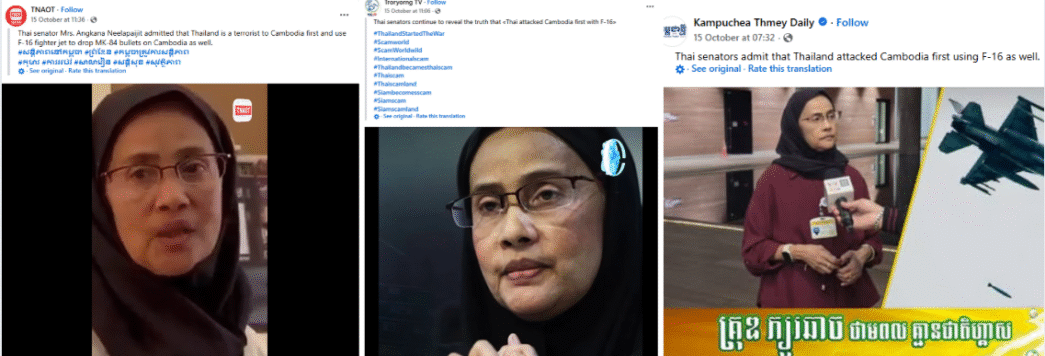
Subsequently, Thai media outlets and social media users cut her remarks, leaving only the portion referring to Thailand’s use of F-16s in response to Cambodia. For example, the Facebook page Khom Chad Luek posted “Stoking the flames? ‘Senator Angkhana’ responds to the Cambodia issue, but this is the answer we get.” alongside an image quoting her as saying, “Frankly speaking, when Thailand used F-16s to strike into Cambodia, they suffered significant losses.” this post had more than 31,400 comments (21 November), most of them attacking Angkhana, and was shared over 3,500 times. Subsequently, Cambodian media outlets used the truncated quote to falsely claim that Senator Angkhana had “admitted that Thailand attacked Cambodia first and used F-16 fighter jets to bomb Cambodia,” including outlets such as TNAOT, Kampuchea Thmey, and Troryorng TV.
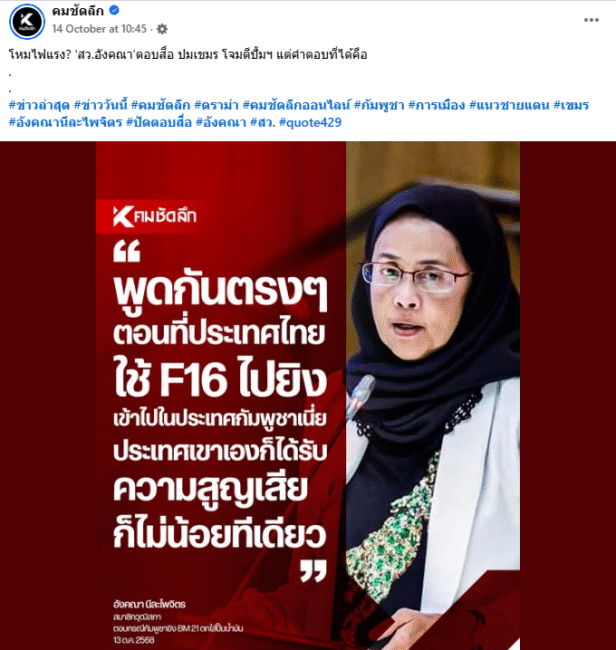
In reality, Angkhana never stated that Thailand attacked Cambodia first.
This distortion by the Cambodian media further intensified anger and hatred toward Angkhana. Influencers and social media users accused her of providing Cambodia with statements that could be twisted for propaganda purposes.
In response, the Royal Thai Army issued a statement countering the Cambodian media’s misrepresentation, stating “Regarding Cambodian media reports claiming that Ms. Angkhana Neelapaijit, a Thai Senator, ‘admitted to the media that Thailand used F-16 fighter jets to drop MK-84 bombs and attack Cambodia first,’ an investigation found that this was a distortion. The reports twisted Ms. Angkhana’s statement that ‘Thailand’s use of F-16s to strike Cambodia also caused Cambodia significant losses’ and fabricated news content that led to public misunderstanding.”
2) Disinformation concerning Lawyer Somchai Neelapaijit
Disinformation about Lawyer Somchai Neelapaijit has been produced and circulated for many years, and has resurfaced once again to incite hatred against Angkhana Neelapaijit, his wife. This includes false claims about the events and legal proceedings in his case, as well as mocking and ridiculing the tragedy of a victim of enforced disappearance for entertainment purposes, for example:
- The Facebook page “เสธPlay”, with nearly 120,000 followers, posted:
“After reading this woman’s post, the only thing I feel is that back then, the perpetrators shouldn’t have taken only Lawyer Somchai.” - The X (Twitter) account “เจ๊จุก คลองสาม” posted:
“…about her husband disappearing — he might not actually be dead. He may have disappeared because he has a new wife.” - The X account “นอนอ” posted:
“The real secret is that Lawyer Somchai is not dead. He is now in Malaysia under the protection of Anwar’s son (former Malaysian prime minister), who is the leader of southern insurgents. This was all part of a plan to destroy Thailand — and Angkhana knows all of this.”
What happened to Lawyer Somchai?
Cofact summarizes the facts concerning the enforced disappearance of Lawyer Somchai and the court rulings in this case, based on reports by the International Commission of Jurists (ICJ), media coverage, and Angkhana Neelapaijit’s lecture delivered on 14 October 2020, titled “Disappeared Human Rights: Absence, Non-Existence, and the Shameless Culture of State Impunity,” as follows:
Somchai Neelapaijit was a human rights lawyer who provided legal assistance to security-related suspects in Thailand’s southern border provinces. He was forcibly disappeared at the age of 53.
Eyewitness testimony presented in court stated that on 12 March 2004, at approximately 8:00 p.m., Somchai drove out of Soi Ramkhamhaeng 65 onto Ramkhamhaeng Road. Around 8:30 p.m., a car following behind collided with his vehicle. Somchai got out of his car to speak with five men traveling in the other vehicle. During this encounter, he was pushed into that car. Later, Somchai’s car was found abandoned on Kamphaeng Phet Road, near the Mo Chit bus terminal.
Somchai’s abduction occurred just two days before he was scheduled to travel to Narathiwat Province to submit a letter to then-Prime Minister Thaksin Shinawatra, calling for the repeal of martial law in the southern border provinces.
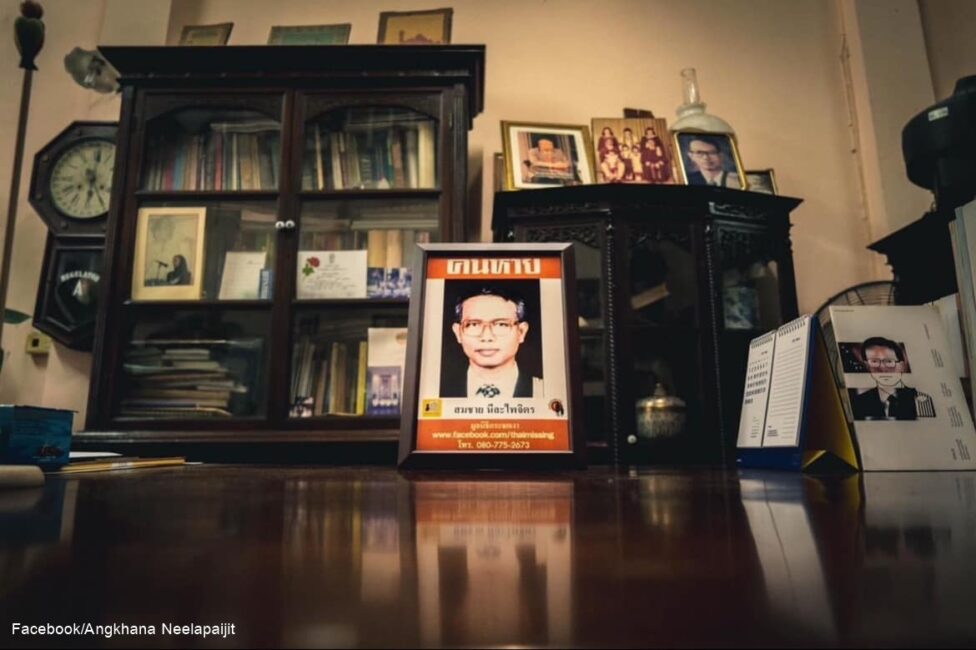
Between 8 and 29 April 2004, the Criminal Court issued arrest warrants for five police officers on charges of jointly robbing Somchai and coercing him into a vehicle through the use of force. Three of the five suspects were police officers assigned to the investigation team of the weapons robbery at Pi Leng Camp, Narathiwat, which occurred in the early morning of 4 January 2004. One of them was Police Lieutenant Colonel Ngern Thongsuk, an officer under the Crime Suppression Division.
Angkhana, who described herself as “an ordinary woman whom no one knew,” came forward to demand justice and pursued the case for more than a decade. The trial court allowed the family to participate as co-plaintiffs alongside the public prosecutor.
The trial court began hearings on 12 July 2005 and, after approximately four months, issued its judgment on 12 January 2006, sentencing Pol. Lt. Col. Ngern, the first defendant, to three years’ imprisonment for coercing another person to act or refrain from acting through the use of force. He was granted bail pending appeal. The other four defendants were acquitted due to insufficient evidence.
Angkhana appealed the ruling. During the appeal process, on 19 September 2008, police reported that Pol. Lt. Col. Ngern had disappeared in a landslide incident, and the Civil Court later declared him a missing person.
On 11 March 2011, the Court of Appeal overturned the conviction and acquitted Pol. Lt. Col. Ngern, while upholding the acquittal of the remaining defendants. The court also ruled that the family could no longer participate as co-plaintiffs.
Angkhana then appealed to the Supreme Court. On 29 December 2015, the Supreme Court upheld the Court of Appeal’s decision, acquitting all five police officers who had been charged in the case.
In her lecture on 14 October 2020, Angkhana stated:
“With respect for the court, I cannot agree with the Supreme Court’s ruling that ‘it is conclusively established that Somchai Neelapaijit was forced into a car and taken away by a group of individuals.’ Although there were many eyewitnesses, they were threatened and did not dare to identify the perpetrators in court. Forensic evidence that investigators claimed was abundant never appeared in court. Ultimately, even though the judgment confirmed that Somchai was taken away by a group of people, the law could do nothing. The law could not protect victims of crimes committed by the state in this manner.”
The International Commission of Jurists (ICJ) has stated that although the Thai government paid compensation to the Neelapaijit family on the basis that Somchai was a missing person, “the failure to clarify the circumstances of Somchai’s enforced disappearance contradicts repeated declarations of intent by successive prime ministers, the Attorney General, and relevant state officials to seek justice or, at the very least, to establish the truth.”
Therefore, claims circulating on social media that Lawyer Somchai was killed by insurgents, is still alive abroad, or deliberately abandoned his wife and family are baseless allegations and inconsistent with the Supreme Court judgment, which established as fact that Somchai was forcibly taken away by a group of individuals, while acquitting all five police officer defendants due to insufficient evidence.
3) Human rights defenders protect Cambodians but not Thais
One of the accusations used to attack Angkhana Neelapaijit in the context of the Thai–Cambodian conflict is the claim that human rights defenders remained silent when Cambodia attacked Thailand, resulting in Thai deaths and injuries. Examples include:
- The TikTok account “yaaikinv11” posted a video on 15 October attacking Angkhana, whom the creator derogatorily called “Aunt Ang Khmer,” saying:
“Aunt Ang Khmer sympathizes with Cambodians affected by ghostly sound clips from the Thai side. Aunt Ang Khmer feels sorry for Cambodians hit by Thai F-16s. But Aunt Ang Khmer has never once expressed sympathy for Thai people who lost their lives, or even for brave Thai soldiers who lost their legs to landmines and died in recent fighting…” - The X (Twitter) account “Ton Patiwat” posted on 15 October:
“Go look back at Angkhana’s Facebook… there isn’t a single post condemning Cambodia’s actions in killing Thai civilians with rockets between 24–28 July 2025.” - The Facebook account “Jo Montanee” posted:
“She was completely silent when Thai mothers hugged their children while fleeing Cambodian shelling and died inside a 7-Eleven. She was also silent when brave soldiers lost their legs to Cambodian landmines. The country she defends — and she still dares to take Thai taxpayers’ money as a salary of hundreds of thousands of baht per month. For what?”
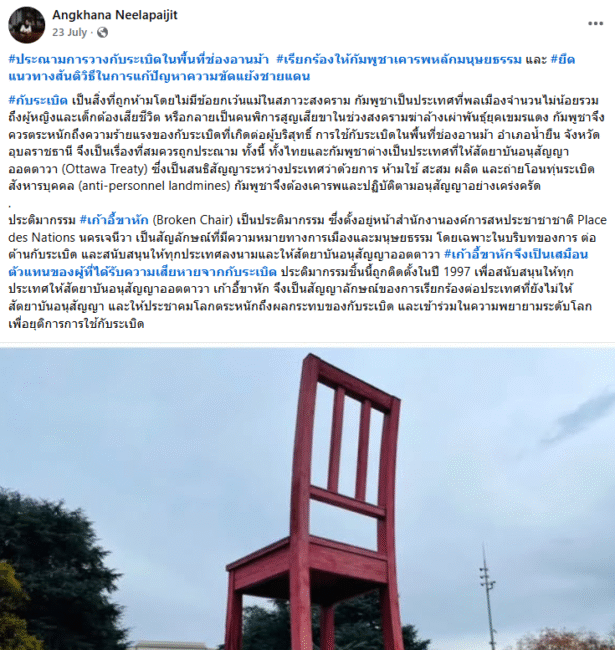
Cofact’s investigation found that Angkhana had, in fact, condemned Cambodia’s use of landmines. On 23 July, she posted on Facebook calling on Cambodia to respect humanitarian principles and to adhere to peaceful means in resolving the border conflict.
“The use of landmines in the Chong An Ma area, Nam Yuen District, Ubon Ratchathani Province, is something that deserves condemnation. Both Thailand and Cambodia are States Parties to the Ottawa Treaty, an international treaty prohibiting the use, stockpiling, production, and transfer of anti-personnel landmines. Cambodia must therefore strictly respect and comply with this convention.” Angkhana wrote in her Facebook post.
In addition, on 4 August 2025, Angkhana gave an interview to reporters at Parliament regarding the meeting of the Thai–Cambodian General Border Committee held in Malaysia. She criticized actions by Cambodia that could constitute violations of the ceasefire agreement and proposed that the Thai delegation urge Cambodia to comply strictly with the agreement.
Regarding the clashes between 24–28 July, which resulted in Thai civilian and military deaths from Cambodian weapons, Angkhana did not post on Facebook or give interviews directly addressing those incidents. However, she explained that at the time, the Thai military had already responded proportionately, and that human rights defenders were deeply concerned about the safety of the population.
Angkhana affirmed that she has always prioritized the protection of the human rights of Thai people, citing, for example, the unrest in Thailand’s southern border provinces, where she has consistently spoken out to condemn bombings of temples and schools. She has also worked on many other cases during her tenure as a member of the National Human Rights Commission of Thailand. Nevertheless, human rights work is not about protecting the citizens of only one country, and the primary duty to protect human rights lies with the state.
“The fundamental principle of human rights work is that all human beings are equal and must not be discriminated against on the basis of race, skin color, religion, or differing political views,” Angkhana told Cofact.
4) Falsification of Wikipedia biography
On 15 October, someone edited Angkhana Neelapaijit’s biography and personal information on Wikipedia, inserting false information as well as vulgar and religiously offensive language. Examples included claims such as: “Angkhana was born in Poipet Province, graduated from Poipet College 168, and later became the leader of a major call-center scam gang,” “a senator representing the cancer patients’ group,” and that she was known as a “Cambodian human rights activist,” among others.
Although the page was later corrected, Wikipedia allows users to view edit histories. Screenshots of the false information were subsequently circulated on social media platforms such as TikTok and X, resulting in the widespread dissemination of false claims about Senator Angkhana originating from Wikipedia. These false claims continue to be accessible today.
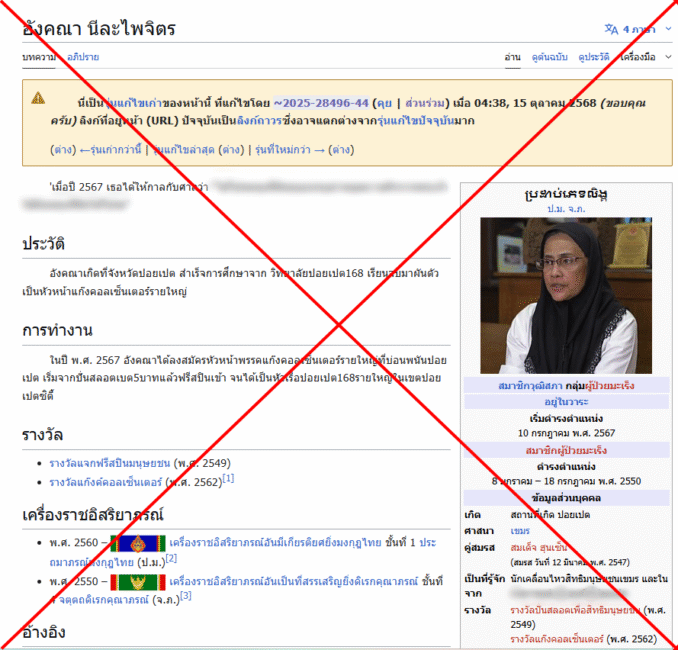
Based on Angkhana’s official biography, publicly available information, and interviews conducted by Cofact, it can be confirmed that Angkhana was born in Phra Nakhon District, Bangkok. She completed her primary and secondary education at Santa Cruz Convent School, Thonburi, before enrolling in the Faculty of Nursing, Mahidol University. She later served as a registered nurse at Siriraj Hospital, prior to becoming a human rights defender following the abduction and enforced disappearance of her husband, Lawyer Somchai Neelapaijit.
Angkhana has held numerous key public positions, including member of the Constitution Drafting Committee, National Human Rights Commissioner, and member of the current Senate. The relevant regulations and laws governing these positions all require that office holders be Thai citizens by birth.